
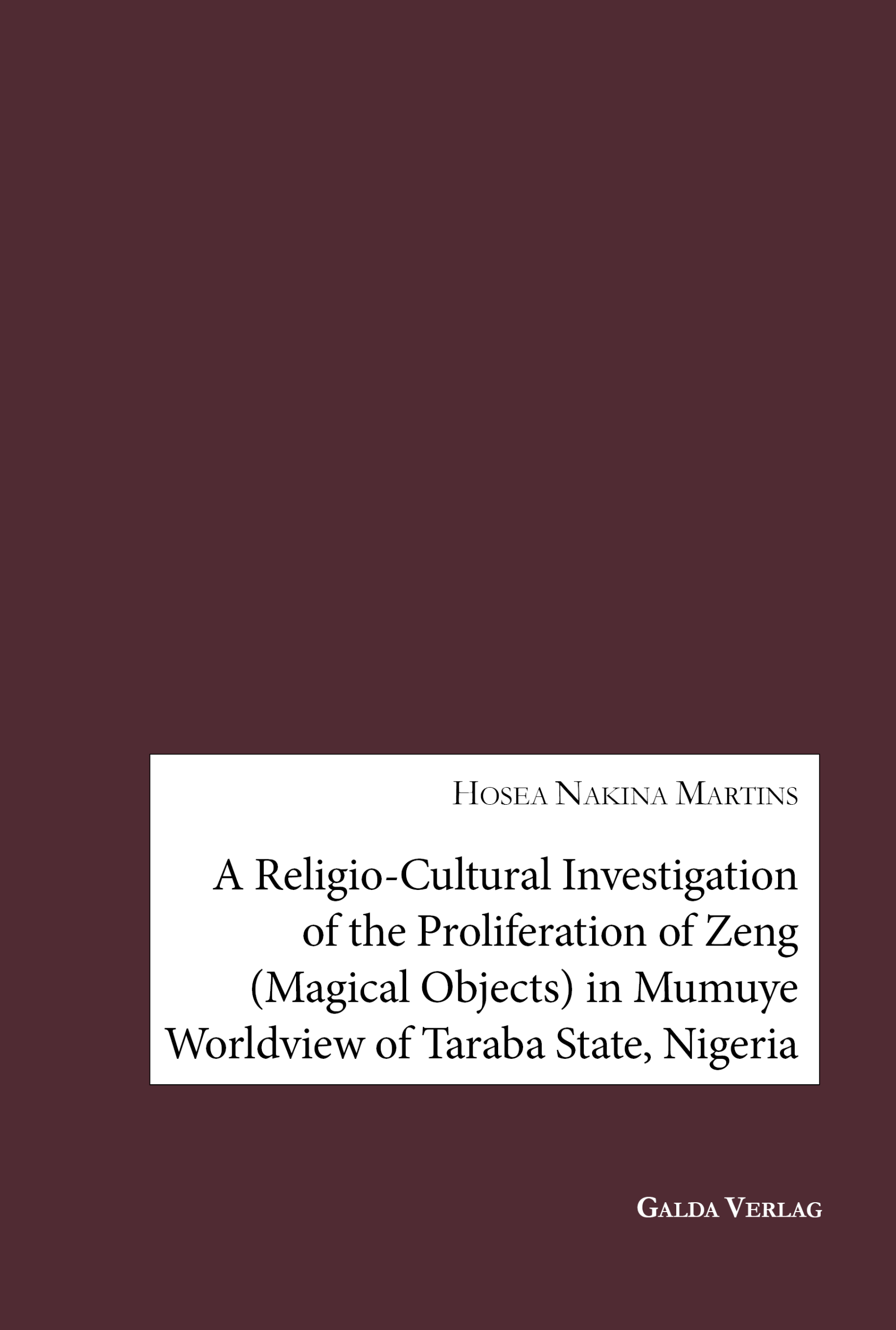
A Religio-Cultural Investigation of the Proliferation of Zeng (Magical Objects) in Mumuye Worldview of Taraba State, Nigeria
58,00 €
Your Legal Guarantee Rights

This book examines the proliferation of Zeng (magical objects) within the Mumuye worldview of Taraba State, Nigeria, including its traditional significance, changing practices and present social consequences. Traditionally, Zeng, empowered by wung (spiritual power), served for self-defence and for the protection of farms, livestock and communities. Its commercialisation and reported misuse have since raised concerns about exploitation, human rights violations, communal mistrust, psychological trauma and the loss of lives and property. The study is based on qualitative research in five local government areas of Taraba State and uses ethnographic, phenomenological and historical approaches. Drawing on the symbolic anthropology of Clifford Geertz and Victor Turner, it interprets the cultural meanings of Zeng and its place in Mumuye religious beliefs and social relationships. Among the factors contributing to its proliferation, the findings identify jealousy, selfishness and ignorance. The book discusses the tension between the protective functions of Zeng and its harmful uses today, which affect human dignity, social cohesion and community wellbeing. It places these issues within wider debates on African traditional religion, indigenous knowledge, cultural change and community security. The study recommends culturally informed public education, alternative livelihood opportunities, accountable traditional leadership, stronger community institutions and interfaith dialogue. It is addressed to scholars, policymakers and development practitioners working on cultural heritage, human rights and community security.
Hosea Nakina Martins, PhD, is Senior Lecturer in the Department of Christian Religious Studies, Faculty of Religion and Philosophy, at Taraba State University, Jalingo, Nigeria. He holds a Bachelor of Arts in Philosophy from the Pontifical Urbaniana University, Rome, a Master's degree in Religious Studies (African Religion) from Benue State University, Makurdi, and a PhD in Religious Studies (African Religion) from Rev. Fr. Moses Orshio Adasu University, Makurdi. His research interests include indigenous medicine and healing, magic and security, spirits (Raamang) and secret societies (Vaa), environmental management, indigenous approaches to peacebuilding and conflict resolution, and African philosophy and values.
T A B L E O F C O N T E N T S
CHAPTER ONE:
INTRODUCTION
1.1 Background to the Study 1
1.2 Statement of the Problem 4
1.3 Aim and Objectives of the Study 4
1.4 Significance of the Study 5
1.5 Methodology of the Study 5
1.5.1 Methods of Data Collection 6
1.5.2 Methods of Data Analysis 7
1.6 Scope of the Study 7
1.7 Theoretical Framework 8
1.8 Organisation of Chapters 9
1.9 Definition of Key Terms/Concepts 10
CHAPTER TWO:
A REVIEW OF RELATED LITERATURE
2.1 The Concept of Magic 13
2.2 Origin of Magic 15 2.3 Forms of Magic 15
2.4 Uses of Magic 18
2.5 History of Magic 19
2.6 Magic in Religious Perspective 20
2.6.1 African Religion 20
2.6.2 Christianity 22
2.6.3 Islam 23
2.7 The Effects of Magic 23
2.7.1 Positive 24
2.7.2 Negative 24
2.8 Empirical Review 25
2.9 Knowledge Gap in Literature 31
CHAPTER THREE:
THE PROLIFERATION OF ZENG (MAGICAL OBJECTS) IN MUMUYE RELIGIOUS WORLDVIEW
3.1 The Mumuye of Taraba State 33
3.1.1 Origin and Migration 34
3.1.2 Geographical Location 35
3.1.3 Socio-Political Organisation 37
3.1.4 Economy 42
3.2 Mumuye Religious Worldview 43
3.2.1 Belief in Kpanti-Laa/Daa-Dapeng/Daa-Lapa (The Supreme Being) 44
3.2.2 Zopi/Nee Tete (Ancestors) 45
3.2.3 Raamang/vuutanang (Spirits) 49
3.2.4 Nwungvaa/Gboleng (Witchcraft) 50 3.2.5 So-Zopi /bura-rena (Reincarnation) 52
3.2.6 Mang/Sok Gola (Rainmaking) 52
3.2.7 Belief in Gang/Ganang/Gbal/Hanang (Traditional Medicine) 53
3.2.8 Vaka/Vaa (Secret Cult or Indigenous Fraternity ) 57
3.3 Zeng (Magical Objects) in Mumuye Religious Worldview 59
3.3.1 Historical Origin of Zeng 65
3.3.2 Nature and Composition of Zeng 67
3.3.3 Interactions of Zeng in the Physical and Non-Physical Worlds 71
3.3.4 Forms of Zeng 76
3.3.5 Habitations of Zeng 78
3.3.6 Acquiring the Knowledge of Zeng 78
3.3.7 Acquiring Magical Powers for the Proliferation of Zeng 81
3.3.8 Ways of Sending Zeng to Attack a Person or Things 84
3.3.9 Avenues for the Proliferation of Zeng 89
3.3.10 Symptoms of Zeng Attacks 90
3.4 Uses of Zeng in Mumuye Religious Worldview 93
CHAPTER FOUR:
FACTORS RESPONSIBLE FOR THE PROLIFERATION OF ZENG (MAGICAL OBJECTS) AMONG THE MUMUYE OF TARABA STATE
4.1 Demand for and Refusal of Friendship of the Opposite Sex 101
4.2 Greed and Selfishness 103
4.3 Pride and Arrogance 104
4.4 Disrespect to Constituted Authority and Customary Norms 106
4.5 Desecration of Jaa-Vaa/Kuna (Shrines) 107
4.6 Self Defense 111 4.7 Nung Doo, Hak, sigin (Envy and Jealousy) 114
4.8 Poverty/Means of Livelihood 116
4.9 Conflict Over Land and Widowhood Inheritance 117
4.10 Acting in Ignorance 118
4.11 Testing the Efficacy of Zeng 119
4.12 Gazing at Vaa/Vaka (Secret Cult Emblems) 120
4.13 Prerequisites for Age Grade/Initiation 122
4.14 Security/Hunting Purposes 123
4.15 Aggressive Nature and Demand of Zeng to be Set Free 126
4.16 Awakened Consciousness on the Need to Take Antidotes Against the Attacks of Zeng 127
4.17 Gift 127
CHAPTER FIVE:
EFFECTS OF THE PROLIFERATION OF ZENG (MAGICAL OBJECTS) ON THE MUMUYE OF TARABA
STATE
5.1 Positive Effects of the Proliferation of Zeng 131
5.1.1 Cultural Preservation and Identity 132
5.1.2 Community Cohesion and Support 134
5.1.3 Protection and Defense Mechanisms 137
5.1.4 Economic Opportunities 140
5.2 Negative Effects of the Proliferation Of Zeng 142
5.2.1 Human Rights Violations 142
5.2.2 Mutual Suspicion and Hatred 145
5.2.3 Underdevelopment 147
5.2.4 Psychological Effects 150
CHAPTER SIX:
WAYS OF COMBATING THE PROLIFERATION OF ZENG (MAGICAL OBJECTS) ATTACKS AND THEIR HARMFUL EFFECTS ON THE MUMUYE OF TARABA STATE
6.1 Ways of Combating the Proliferation and Attacks of Zeng (Magical Objects) 153
6.1.1 Role of the Family 153
6.1.2 Role of the Traditional Institution 155
6.1.3 Role of Religious Leaders 156
6.1.4 Role of the Mass Media 157
6.1.5 Role of Age Grade 158
6.1.6 Government Legislation 158
6.2 Obstacles to the Proliferation and Efficacy of Zeng 159
CHAPTER SEVEN:
SUMMARY, CONTRIBUTION TO KNOWLEDGE, RECOMMENDATIONS AND CONCLUSION
7.1 Summary 163
7.2 Contribution to Knowledge 164
7.3 Recommendations 165
7.4 Conclusion 166
WORKS CITED 169
APPENDIX I 179
APPENDIX II 195