
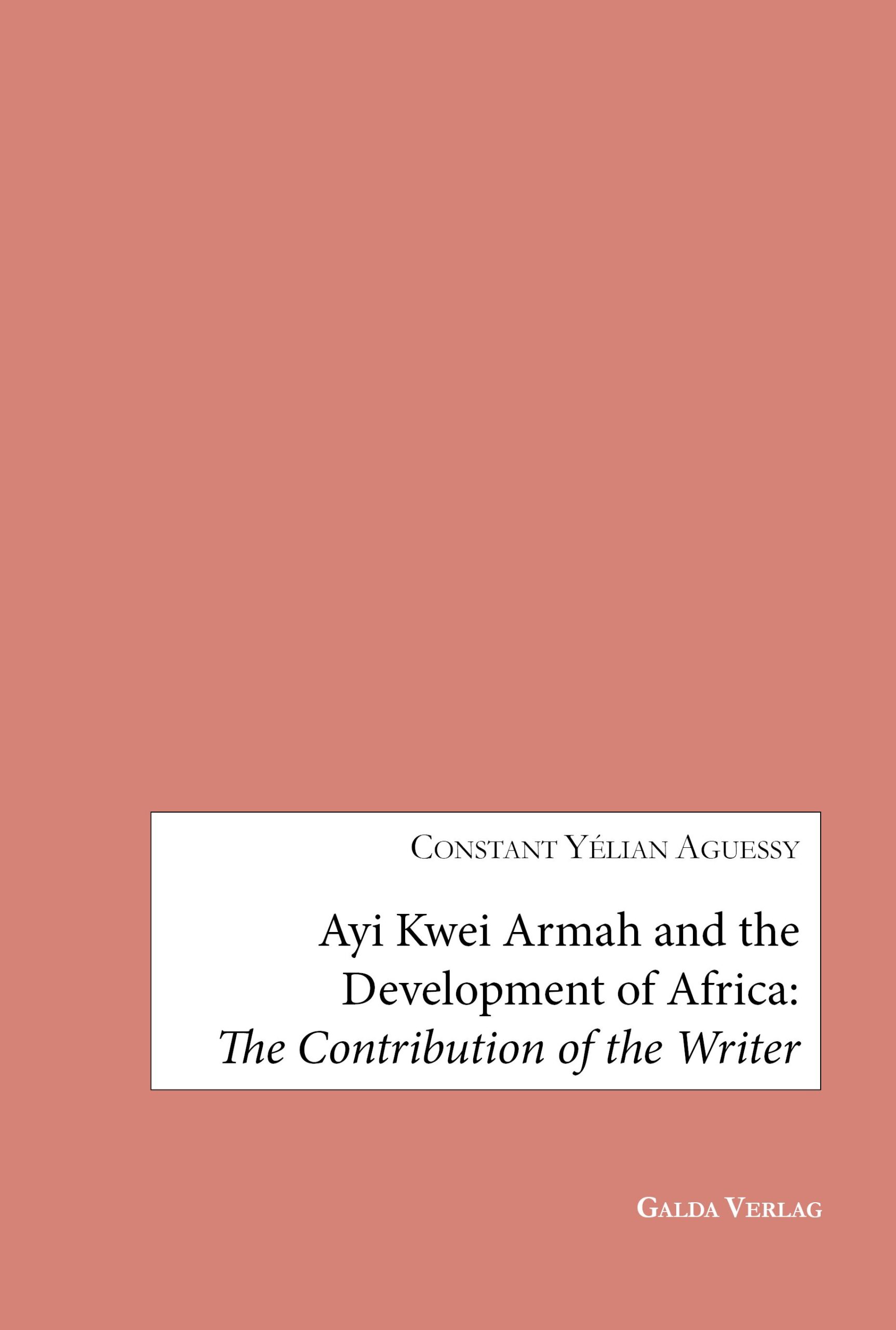
Ayi Kwei Armah and the Development of Africa: The Contribution of the Writer (PDF)
39,99 €
Your Legal Guarantee Rights
Drawing on Ayi Kwei Armah’s major novels — among them Two Thousand Seasons, Osiris Rising, and KMT: In the House of Life — this study examines the historical and structural obstacles that have hindered African development since independence, from feudal and colonial legacies to neo-colonial exploitation, corruption, and cultural alienation. It further explores Armah’s own literary contribution to imagining the continent’s reconstruction, from his concept of the “Sphere” as a model of shared knowledge to his founding of the Per Ankh Publishing House. Originally presented as a doctoral dissertation at the Université d’Abomey-Calavi (Benin), the book offers literary scholars, Africanists, and students of postcolonial theory a framework for understanding African fiction as a vehicle for continental renewal.
Dr. Constant Yélian Aguessy is Maître de Conférences (CAMES-accredited Associate Professor) at the Université de Parakou, Benin. He holds a Ph.D. in English Literature from the Université d'Abomey-Calavi, where his research focused on African literature and the works of Ayi Kwei Armah. He has since published widely on African and postcolonial literature in regional and international academic journals.
T A B L E O F C O N T E N T S
DEDICATION i
ACKNOWLEDGMENTS iii
INTRODUCTION 1
PART ONE:
THE OBSTACLES TO AFRICAN DEVELOPMENT
AS SEEN IN ARMAH’S NOVELS
Chapter One:
Background to Africa’s Development Problems
1.1 Feudalism as a Handicap to Social Construction 21
1.2 Persecution 22
1.3 Migration 26
1.4 The Responsibility Problem of the African Leaders 31
1.5 The Pyramidal System, a Cultivation of Underdevelopment 35
1.6 Deification of the African Leaders 39
Chapter Two:
Africa’s Development Problems in Armah’s Novels
2.1 Historical Context 43
2.2 Slave Trade in Two Thousand Seasons, Osiris Rising: a novel of Africa past, present and future and KMT: in the house of life. 44
2.3 Colonialism, a Handicap to Africa’s Development 49
2.3.1 Meaning and Justification 49
2.4 Colonial Exploitation, a Cause of Underdevelopment 50 2.4.1 Exploitation of Human Beings 50
2.4.2 Sheer Exploitation of the African Natural Resources 52
2.4.3 Dislocation of the Socio-political and Economic System 55
2.5 Religious Obstacles 61
2.5.1 Alienation 61
2.5.2 Modern Obstacles 68
2.5.2.1 Neo-colonialism, a Network of the European Gangsters 68
2.5.2.2 Capitalism and Imperialism as Grassroots of African Underdevelopment. 76
PART TWO:
THE IMPEDIMENTS TO THE RECONSTRUCTION OF POST INDEPENDENCE AFRICA
Chapter Three:
Literary Articulation of Social and Economic Impediments
3.1 The Cult of Personality as a Retardation Vector of Africa 83
3.2 Nepotism, a Social Calamity 84
3.2.1 Corruption, the Deadlock for the Development of Africa 86
3.2.2 The “brain-drain” a Bedrock of African Underdevelopment 93
3.2.2.1 Unbalanced Partnership in Terms of Exchange 95
3.2.2.2 The Retardation of the Industrialisation of Africa 98
Chapter Four:
Cultural Impediments
4.1 Loss of Identity 101
4.2 Colonial Languages and Their Impacts on the Continent 106
4.3 The Role of the Colonial Education in the Backwardness of the Continent 109
Chapter Five:
Political Impediments
5.1 The Failure of the Ideologies and Its Impacts on the Africans 111
5.2 Political Instability 118
5.3 Dictatorship Exercised on the African People 121
5.4 War as an Indicator of Backwardness 126
PART THREE:
ARMAH’S CONTRIBUTION TO THE DEVELOPMENT OF THE AFRICAN CONTINENT
Chapter Six:
Fundamental Conditions for Development in Armah’s Novels
6.1 Notions of Development 135
6.2 Concept of “Sphere” in the Process of Knowledge Acquisition 137
6.3 Vision of Change 141
6.4 Africa in Transition 150
6.5 Integration of the Continent 155
6.6 Rethinking of the Educational System. 156
6.7 Necessity of Literature to the Development of Africa. 161
Chapter Seven:
The Importance of History to Ayi Kwei Armah as a Novelist
7.1 The Return to the Past as a Way to Development 179
7.2 Connectedness of the Past to the Present as a Base of Remaking the Continent 188
7.3 Myths in Armah’s Works 192
Chapter Eight:
Armah’s Personal Commitment to the Reconstruction of Africa
8.1 The Writer’s Early Education as a Springboard to Development 199
8.2 Is Ayi Kwei Armah’s Literary Message Pessimism or Optimism? 203
8.3 Some Literary Devices and Social Consciousness 207
8.4 The Foundation of the Per Ankh Publication House 212
8.5 The Fight for the Overall Liberation of the Continent 213
CONCLUSION 221
BIBLIOGRAPHY 225