
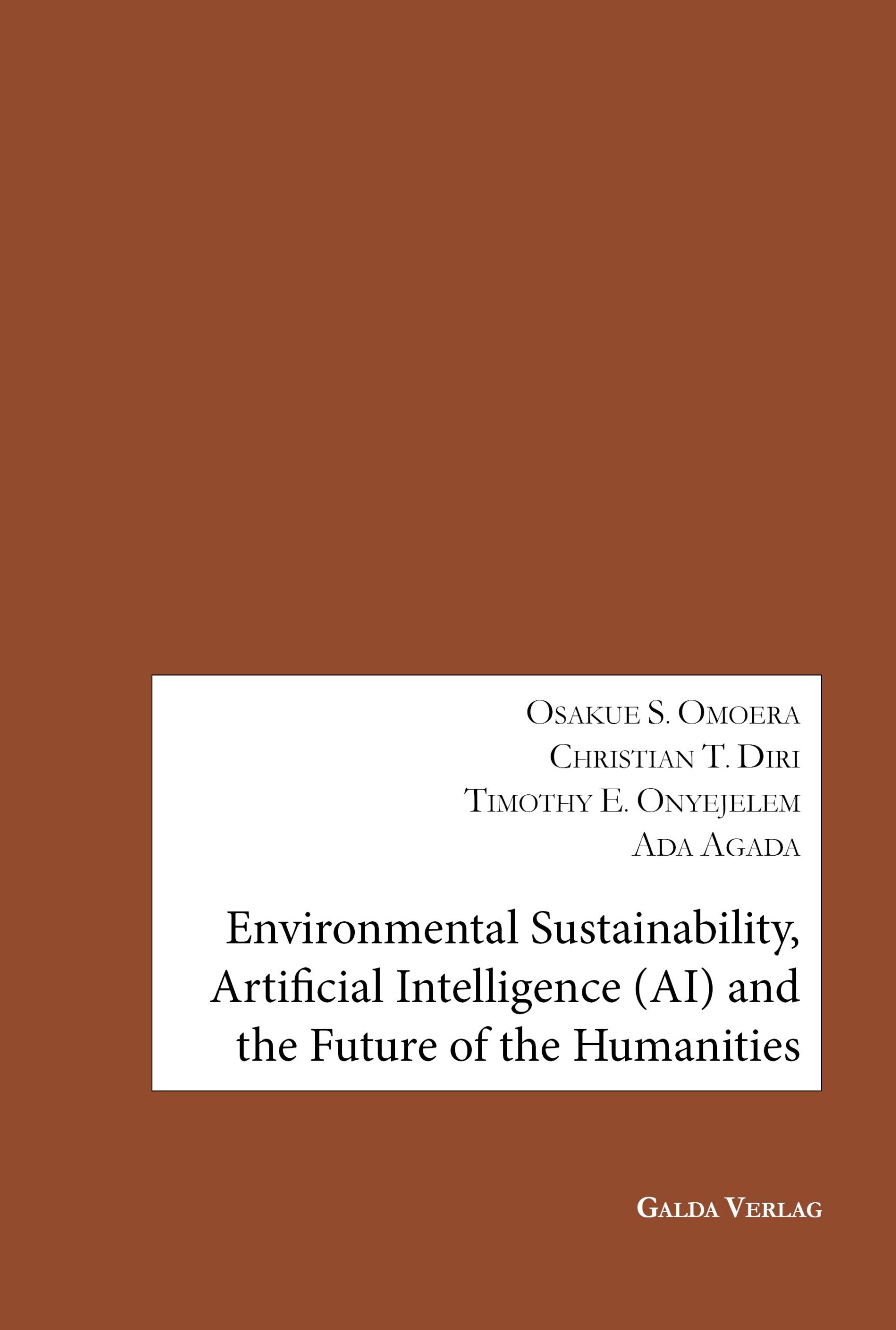
Environmental Sustainability, Artificial Intelligence (AI) and the Future of the Humanities
98,00 €
Your Legal Guarantee Rights

Since the dawn of the 21st century, the collective existence of humanity has been defined by two intersecting forces: the accelerating crisis of environmental injustice and the disruptive rise of Artificial Intelligence (AI). As these forces reshape the global landscape, the role of the humanities has become more crucial than ever. The humanities are no longer merely passive observers of the world; they are the interpretative and ethical anchors required to navigate a technological era that threatens to outpace our moral and cultural frameworks. Environmental Sustainability, Artificial Intelligence (AI) and the Future of the Humanities offers a comprehensive and multi-disciplinary exploration of these dynamics by bringing together diverse perspectives to interrogate how humanistic inquiry can humanise technology and safeguard our natural and cultural environments.
Ada Agada is a senior lecturer in the Department of Philosophy, Faculty of Humanities, Federal University Otuoke, Bayelsa State, Nigeria. He is a leading African philosopher. ORCID: https://orcid.org/0000-0002-3616-3608
Christian Tuotamuno Diri is the Director, Media and Communications, Federal University Otuoke, and Head, Department of Journalism and Media Studies, Faculty of Humanities, Federal University Otuoke, Bayelsa State, Nigeria. ORCID: http://orcid.org/0009-0005-0312-5786
Osakue Stevenson Omoera, Ph.D., is an expert in applied media, film and theatre studies. He teaches and conducts research in media sociology, Nollywood studies, development communication, and African theatre and cultural dynamics at the Federal University Otuoke, Nigeria, where he chairs the Department of Theatre and Film Studies. He is also an Adjunct Professor at the National Open University of Nigeria, Abuja.
Timothy Ekeledirichukwu Onyejelem is a senior lecturer in the Department of Journalism and Media Studies, Faculty of Humanities, Federal University Otuoke, Bayelsa State, Nigeria. ORCID: https://orcid.org/0009-0005-8654-8978
T A B L E O F C O N T E N T S
Dedication i
Acknowledgements iii
Introduction: Environmental Sustainability, Artificial
Intelligence (AI) and the Future of the Humanities:
An Editorial Overview — Osakue S. Omoera, Christian T. Diri,
Timothy E. Onyejelem, & Ada Agada
1
SECTION 1:
REDEFINING THE HUMANITIES IN A DIGITAL FUTURE
Chapter 1: Environmental Sustainability, Artificial Intelligence (AI)
and the Future of the Humanities — Elo Ibagere 7
Chapter 2: Educators as Healers and Mentors in the AI Era:
Resilience, Emotional Learning, and Social Connection
— Anna Odrowąż-Coates
17
Chapter 3: Communicating Environmental Sustainability in
the Era of Artificial Intelligence: The Role of Nigerian Humanities
in a Digital Future — Chigozi Eke and Akpoebi Alex Bufumoh
27
Chapter 4: Harnessing Artificial Intelligence for
Environmental Sustainability: A Communication-Centred
Approach to Transforming the Nigerian Humanities
— Chigozi Eke and Nneoma Nora George
51
Chapter 5: Evaluating Students’ Use of Artificial Intelligence-Based
Tools in the Learning of Christian Religious Studies Concepts
in University of Calabar, Cross River State, Nigeria
— Ozioma O. A. Okoye
79
Chapter 6: Exploring the Intersection of Artificial Intelligence and
Communication Studies: Challenges, Implications and
Future Directions — Blessing Onyinyechukwu Umunnah
99
SECTION 2:
AI IN PROFESSIONAL PRACTICE: JOURNALISM,
PR, AND BROADCASTING
Chapter 7: Heightening Calls for Precision in
Contemporary PR Practice: An Imperative for AI Intervention
— Oyakemeagbegha Musah
115
Chapter 8: Perceptions and Concerns about Artificial Intelligence
Usage in Journalism among Practitioners in Bayelsa State
— Lawrence Kuro Berezi and Ifeanyi Martins Nwokeocha
129
Chapter 9: Artificial Intelligence and the Challenges of
Bias in Journalism Practice — Joyce Osokien Aleme and
Edidiong Ime Inyang
157
Chapter 10: The Practical Use of Artificial Intelligence in
Contemporary Production with a Focus on Broadcasting
— Priscilla Kandoon Aver, Susan Daomonaa Richard-Nweye,
and Doubra Timi-Wood
171
Chapter 11: Artificial Intelligence (AI) and Storytelling/Narrative
Journalism in the Digital Age: Upscaling Opportunities for
Nigeria Media Professionals — Christian Tuotamuno Diri
and Christopher Justice Njoku
189
Chapter 12: Understanding the Fundamentals of Webcasting for
Journalism Education in Nigeria: An Artificial Intelligence (AI)
Dimension — Timothy Ekeledirichukwu Onyejelem
213
SECTION 3:
PRESERVING CULTURAL HERITAGE AND
INDIGENOUS KNOWLEDGE
Chapter 13: Reimagining African Indigenous Performances
through Artificial Intelligence: The Intersection of Tradition
and Technology in Tiv Gbaseela Theatre — Dooyum Haako
235
Chapter 14: AI and Nigerian Language Studies:
The Case of Abureni Language —Sinclair Edwin Edoghotu 249
Chapter 15: Impact of Artificial Intelligence on African Culture:
Issues and Remedies — Jones M. Jaja and Clifford Meesua Sibani 267
Chapter 16: Grammatical Differences and Word Order
Arrangement in Machine Translation of Indigenous Nigerian
Languages — Blessing Ugochi Uwasomba
281
Chapter 17: Protecting our Past through the Future: AI and
Oral Literature Preservation — Phyllis Oniopusaziba Akpoti 299
SECTION 4:
ADDRESSING ENVIRONMENTAL CRISIS AND ECO-INJUSTICE
Chapter 18: Conservation or Colonialism? Education,
Environment, and the Humanities in the Age of
Artificial Intelligence — John Charles Ryan
319
Chapter 19: The Nexus of Artificial Intelligence, Biophilic
Design and Green Architecture — Chukwuemeka S.O. Onwukwe,
Obinna A.C. Ogbuokiri, and Livingstone C. Ibemere
333
Chapter 20: Narrating Eco-Injustice in Oil Producing
Communities in Eastern Nigeria: An Ecocritical Evaluation
of Inno Ejike’s Oil at My Backyard — Patricia Ngozi Anyanwu
359
Chapter 21: Artificial Intelligence for Climate Change: Adopting
Eco-Poetry for Environmental Sustainability in the Global South
— Joyce Austen Onyekuru and Emmanuel C. Ogbonna
379
Chapter 22: Exploring the Intersection of Environmental
Sustainability and Artificial Intelligence in Niger Delta:
An Examination of the Role of AI in Mitigating Oil Spillage
Disasters — Vivian Ifeoma Okpalike, Christopher Obot Daniel,
and George Nathan Brown
405
SECTION 5: ETHICAL GOVERNANCE AND THE MENACE OF
MISINFORMATION
Chapter 23: The Dynamics of Artificial Intelligence (AI)
and Security Studies in Nigeria — Peace Ugochi Ibekwe 437
Chapter 24: Fake News and Social Media in Artificial Intelligence
(AI)–Powered Deepfakes Ecosystem: Need to Strengthen
Regulatory Frameworks in Nigeria — Christian Tuotamuno Diri,
Timothy Ekeledirichukwu Onyejelem, and Joyce Osokien Aleme
451
Chapter 25: An Investigation into the Behavioural Consequences
of Exposure to Synthetic Media — Chikosolu Maureen Onyeanusi 479