
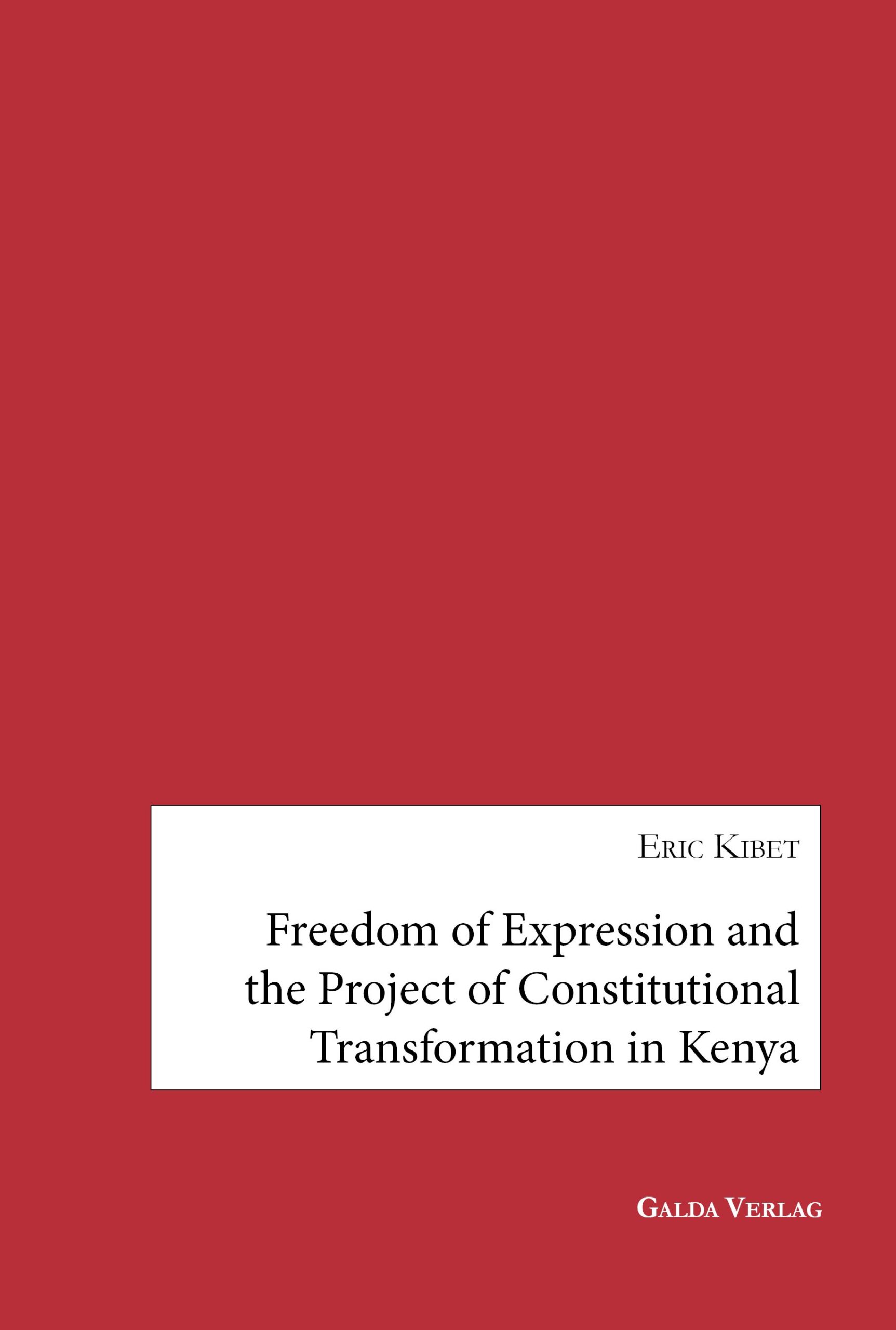
Freedom of Expression and the Project of Constitutional Transformation in Kenya
98,00 €
Your Legal Guarantee Rights

The Constitution of Kenya, 2010 marked a deliberate break from a repressive political past, committing the country to a transformative constitutional order grounded in human dignity, democracy, the rule of law and respect for fundamental rights. This book examines the place of freedom of expression within that transformative project, tracing its historical development, its scope and limitations under Kenyan and international law, and its relationship to the wider goals of the 2010 Constitution. It argues that while the Constitution provides a framework capable of supporting genuine transformation, restrictions on freedom of expression found in statute, common law and judicial precedent continue to undercut the protection of the right, and that some of these restrictions fail to meet constitutional standards. Combining historical, theoretical and comparative analysis, the book offers a critical assessment of Kenya’s constitutional journey and the indispensable role freedom of expression plays in sustaining it, making it a valuable resource for scholars, legal practitioners and policy makers engaged with constitutionalism in Africa.
Dr Eric Kibet is the founding Dean of Zetech University Law School in Kenya. He served as Advisor for Legal, Policy and Regulatory Affairs to the Cabinet Secretary for Information, Communications and the Digital Economy in the Government of Kenya, and Assistant Professor of Law at United States International University (USIU)-Africa. He has also held various tenured and consulting positions in various institutions such as Jomo Kenyatta University of Agriculture and Technology, Kenyatta University, Riara University, Moi University, Strathmore University, Council of Legal Education, and the Kenya School of Law. He holds a Doctor of Laws (LLD) degree from the University of Pretoria, a Master of Laws (LLM) degree from Boston College Law School, and a Bachelor of Laws (LLB) degree from the University of Nairobi. He also holds a postgraduate Diploma in Law from the Kenya School of Law. He is an advocate of the High Court of Kenya, and a Licentiate Member of the Institute for the Management of Information Systems, U.K.
T A B L E O F C O N T E N T S
ACKNOWLEDGEMENTS i
ACRONYMS AND ABBREVIATIONS iii
FOREWORD vii
DEDICATION xi
PREFACE xiii
CHAPTER ONE: Introduction 1
CHAPTER TWO:The Kenyan Polity and the Constitution: A Historical Analysis 11
2.1 Introduction 11
2.2 The Constitution of Kenya in Context 13
2.2.1.1 The Disruptions and Injustices of Colonial Legacy 14
2.2.1.2 The Illegitimacy of the Independence Constitution 16
2.2.1.3 The Unfinished Business at Lancaster and Illegitimate Unmaking of the Independence Constitution 17
2.2.1.4 Emergence of ‘Presidential Imperialism: Politics of Patronage and Centralised Governance 19 2.2.2 External Factors 21
2.2.2.1 The Collapse of the Soviet Union 21
2.2.2.2 Globalisation and Globalism 22
2.2.2.3 Decline of Classical Liberal Ideology 26
2.3 Evolution of the Kenyan State: Pre-colonial Period to Present 32
2.3.1 Colonial Imperialism: 1895-1963 33
2.3.2 Post-Independence Presidential Imperialism: 1964-1992 34
2.3.3 Minimal Liberal Democracy: 1992-2010 34
2.3.4 The Post-2010 era 35
2.4 Conclusion 38
CHAPTER THREE: Evolution, Nature and Scope of Freedom of Expression 39
3.1 Introduction 39
3.2 Historicity of the Freedom of Expression Protection 40
3.2.1 Origin of Freedom of Expression Generally 40
3.2.2 The Elevation of Freedom of Expression to the International Law Realm 44
3.2.3 Freedom of Expression and the Independence Constitution 46
3.3 Freedom of Expression Experiences in Kenya 49
3.3.1 Freedom of Expression Practices in the Colony: 1895-1963 49
3.3.2 Freedom of Expression in Post-Colonial Kenya: the Years of KANU Dominance 1963-2002 51
3.3.3 Freedom of Expression in Post-Colonial Kenya: 2002 to present 63
3.4 Kenya’s International Legal Obligations Relating to Freedom of Expression 71
3.5 Nature, Scope and Components of Freedom of Expression 80
3.5.1 Structure and Architecture of Freedom of Expression Protection 84 3.5.2 Components of Freedom of Expression Protection 87
3.5.2.1 Freedom to seek, receive or impart information or ideas 87
3.5.2.2 Freedom of artistic creativity 90
3.5.2.3 Academic freedom and freedom of scientific research 92
3.5.2.4 Commercial Expression 99
3.6 Relationship between Freedom of Expression and other Rights 106
3.7 Conclusion 110
CHAPTER FOUR: Theoretical Foundations of the Protection of Freedom of Expression 113
4.1 Introduction 113
4.2 Theoretical Justifications of Freedom of Expression 114
4.2.1 Truth Theory 114
4.2.2 Democracy Theory 124
4.2.3 Human Dignity 131
4.2.4 Autonomy Theory 138
4.2.5 Self -fulfillment Theory 142
4.3 Conclusion 146
CHAPTER FIVE: Walking the Tight Rope: Freedom of Expression Limitations 149
5.1 Introduction 149
5.2 The Nature of Freedom of Expression Limitations 150
5.2.1 Internal Limits and External Limits 151
5.2.2 Subsequent Punishment and Prior Restraints 154
5.3 The Balancing Act: Theorising Freedom of Expression Limitations 159
5.4 Political Expression, Limitations and their Justifications 171
5.4.1 National Security and Public Order 172 5.4.2 Rights and Reputation of Others 191
5.4.3 The Authority and Independence of the Judiciary, the Sub Judice Rule, Contempt of Court and Political Expression 206
5.5 Conclusion 216
CHAPTER SIX: Transformative Constitutionalism, the Constitution of Kenya, and its Promise of Transformation 219
6.1 Introduction 219
6.2 Constitutions as Ideology and Agents of Change 220
6.3 Transformative Constitutionalism in the Context of South Africa 222
6.4 Transformative Constitutionalism: The Central Ideology of Kenya’s Constitution 226
6.4.1 Transformative Constitutionalism and
Kenya’s Post-2010 Experiences 228
6.4.2 The Transformative Aims of Kenya’s Constitution 232
6.4.2.1 From Ethical crises to renewal of values 234
6.4.2.2 Symbolic Casting of a National Vision 235
6.4.2.3 Regional, Gender and Ethnic Balance and Merit in appointments 237
6.4.2.4 Mechanisms Designed to Discourage Ethnic Mobilisation 240
6.4.2.5 From Political Repression to Human Rights Protection and Citizen Emancipation 241
6.4.2.6 From Despotism, Failed Dysfunctional State Organs to Revitalised Accountable institutions 246
6.4.2.7 Trimming Presidential Powers, Enhancing Executive and Legislative Accountability and Corresponding Restoration of Parliaments’ Authority 247
6.4.2.8 Independent and Revitalised Judiciary 250
6.4.2.9 Accountability Through Independent Offices and Commissions 252 6.4.2.10 From Highly Centralised Governance to Devolution 254
6.4.2.11 Expansion of Democratic Space and Accountability 257
6.4.2.12 Inclusiveness and National Cohesion 257
6.4.2.13 Foster Economic Development 258
6.4.2.14 Equitable Distribution of National Resources 258
6.4.2.15 Enhanced Service Delivery 259
6.5 Conclusion 259
CHAPTER SEVEN:The Constitution’s Vision of Political Transformation and the Role of Freedom of Expression 261
7.1 Introduction 261
7.2 Theorizing Political Change and the Law in Kenya: a Shift from ‘Authority’ to ‘Justification’ 262
7.2.1 Dismantling the vestiges of the colonial and post-colonial despotism 268
7.2.2 Objectivity in Interpretation and Adjudication of Rights and the Constitution Generally 282
7.2.3 Proportionality Balancing in Limitation of Rights 290
7.3 The Role of Freedom of Expression in Kenya’s Democratic Edifice 296
7.3.1 Freedom of Expression as a Legitimating Factor 296
7.3.2 Freedom of expression as a Facilitating Factor 300
7.3.3 Freedom of Expression as a Defence Factor 306
7.4 Freedom of Expression and the Enduring Paradox 313
7.5 The Quest for a Plausible Approach 315
7.6 Conclusion 320
CHAPTER EIGHT: Conclusions 323
8.1 Introduction 323
8.2 Key conclusions 324
8.3 Concluding remarks 338
LIST OF INSTRUMENTS 341
LIST OF CASES 345
BIBLIOGRAPHY 353