
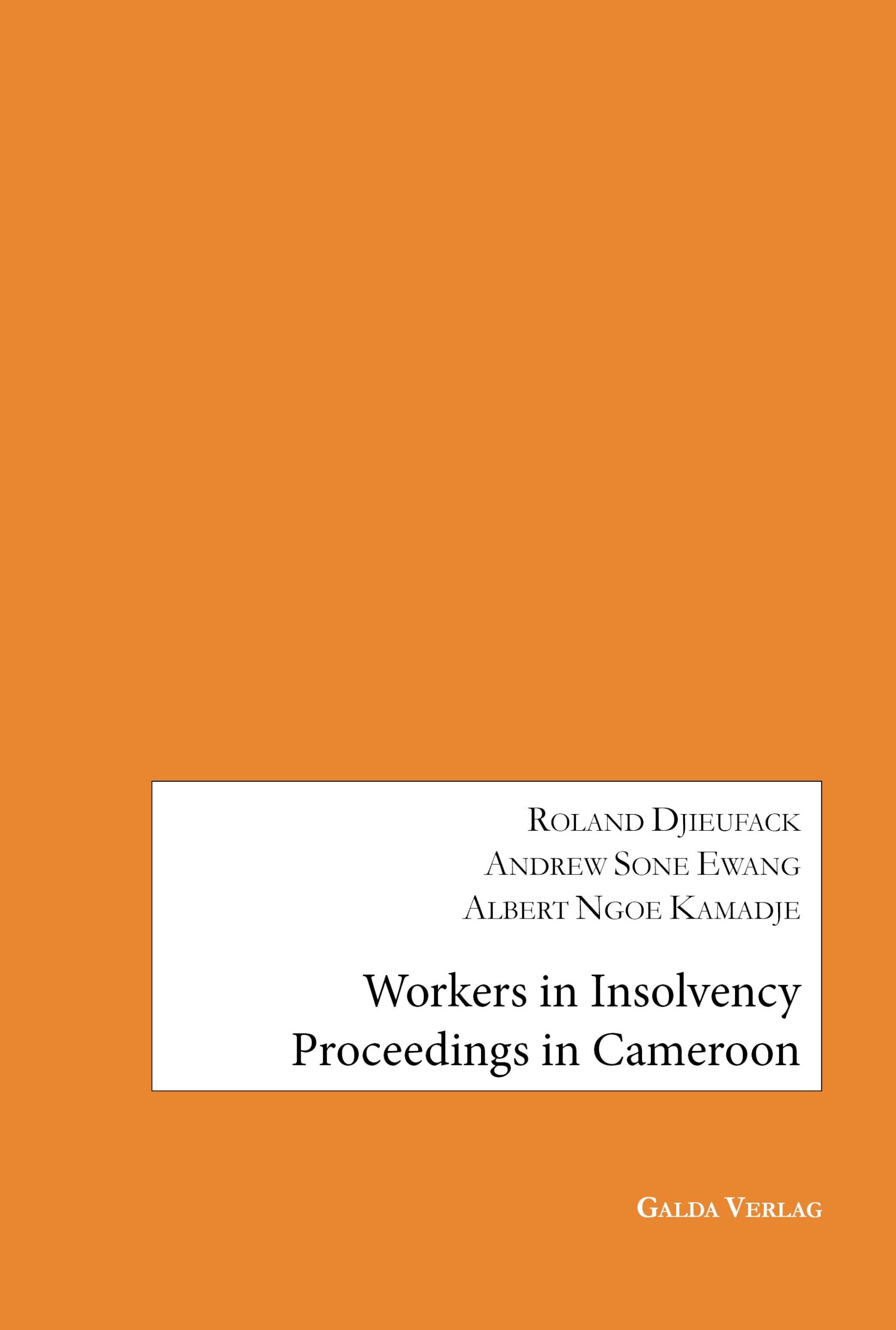
Workers in Insolvency Proceedings in Cameroon
72,00 €
Your Legal Guarantee Rights

The primary concern of this book is to promote conducive employment relations in Cameroon. Cameroon is an economic giant in sub-Saharan Africa, home to a large number of enterprises. Shedding light on underexplored areas of insolvency proceedings in Cameroon has become a hallmark of the authors. This book makes a timely contribution by addressing pertinent cases of violation of the legal rights of workers and employees in Cameroon during insolvency proceedings. Drawing on the OHADA Uniform Act Organizing Collective Proceedings for Clearing of Debts — which regulates insolvency proceedings in Cameroon — as well as other national legal instruments, this study finds that existing regulatory frameworks are beset by significant weaknesses and challenges that undermine the effective protection of employees. From this premise, the book recommends, inter alia, the establishment of an effective employee protection guarantee scheme funded by the government, as well as mechanisms to support redundant employees in re-entering the job market, including retraining programmes and job-search initiatives.
Albert Ngoe Kamadje obtained his LL.M and Ph.D in English Private Law from the University of Dschang, Cameroon. His doctoral thesis explores Labour Law theories to evaluate the effectiveness of protection accorded to workers in Cameroon during insolvency proceedings. His research and publications focus primarily on Labour Law, Insurance Law, and Insolvency Law.
Andrew Sone Ewang is currently an Associate Professor of Law in the Department of English Law, Faculty of Law and Political Science, University of Dschang, Cameroon. His research interests include Criminal Law, Civil Procedure, Electoral Law, Land Law, Commercial Law, Human Rights Law, and Environmental Law. He has published widely in books and journals.
ROLAND DJIEUFACK, (Ph.D), is a Senior Lecturer of Law, Head of Department of Law in the Higher Technical Teachers' Training College, The University of Bamenda, Cameroon. He is also a visiting Lecturer in the Faculties of Laws and Political Sciences in the Universities of Dschang and Buea, Cameroon. He is author of several peer reviewed journal articles in national and foreign journals. His research interest is on Commercial and Consumer Laws.
T A B L E O F C O N T E N T S
DEDICATION i
PREFACE iii
ACKNOWLEDGEMENTS vii
LIST OF LEGAL INSTRUMENTS ix
LIST OF CASES xiii
LIST OF ABBREVIATIONS/ACRONYMS xvii
CHAPTER ONE: GENERAL INTRODUCTION
1.1. Background to the Study 1
1.1.1 Historical Evolution of Insolvency Legal Regime in Cameroon 6
1.1.2 After Independence till Date 9
1.2 The Problem of the Study 13
1.3 Significance of the Study 15
1.4 Significance of Research 16
1.5 Scope of the Study 17
CHAPTER TWO: THE CONCEPT OF INSOLVENCY PROCEEDINGS AND THE RATIONALES FOR EMPLOYEE PROTECTION
2.0 Introduction 19
2.1 Determining Insolvency 21
2.2 Causes of Insolvency 26
2.2.1 External Causes of Insolvency 26
2.2.2 Internal Causes of Insolvency 27
2.3 Principles Characterizing Insolvency Proceedings 29
2.3.1 The Principle of Collectivity 30
2.3.1.1 Advantages of the Collective Nature of Insolvency Proceedings 31
2.3.1.2 Disadvantages of the Collective Nature
of Insolvency Proceedings 31
2.3.2 The Paripassu Principle 32
2.3.3 Judicial Supervision 34
2.4 Types of Collective Procedures Under the UACPCD 36
2.4.1 Preventive Procedures 36
2.4.1.1 Conciliation 36
2.4.1.2 Preventive Settlement 39
2.4.2 Insolvency Procedures 45
2.5 Persons Subject to Collective Proceedings 45
2.6 The Various Actors in Collective Proceedings 47
2.6.1 The Conciliator 47
2.6.2 Receiver 49
2.6.3 Expert 50
2.6.4 Trustee 51
2.6.5 Controllers 53
2.7 The Concept of Employee Protection 54
2.8 Types of Employees 57
2.9 Rationales for Employee Protection 59
2.9.1 Employee Protection as a Tool to Fight Against Unemployment 61
2.9.2 Employee Protection as a Tool to Foster Development 63
2.9.3 Protection of Employees as Unsecured Creditors 64
2.9.4 Employee Protection as a Tool to Reduce Crime Wave 66
2.9.5 Gross Violation of Employees’ Rights as Stakeholders 67
2.10 Conclusion 69
CHAPTER THREE: PROTECTION OF EMPLOYEES DURING REORGANIZATION AND ASSETS LIQUIDATION IN CAMEROON
3.0 Introduction 73
3.1 Reorganization Procedure and Employee Protection 80
3.1.1 Commencement of Reorganization Proceedings 83
3.1.2 Effects of Reorganization Proceedings on Employees as Creditors 87
3.1.3 Declaration and Verification of Claims 90
3.1.4 Technics in Rescuing an Insolvent Company During Reorganization 92
3.1.4.1 Employment or Work-Related Measures 94
3.1.4.1.1 Restructuring of Staff 95
3.1.4.1.2 Reorganization of Working Hours 97
3.1.4.1.3 Recourse to Technical Unemployment 100
3.1.4.2 Pecuniary-Related Measures 102
3.1.5 Treatment of Employment Related Claims During Reorganization 106
3.1.6 Treatment of Employment Contracts During Receivership 112
3.1.7 Restraint of Trade Covenants in Relation to Retrenched Employees 121
3.1.8 Rights of Employees During Reorganization 127
3.1.8.1 Right to Commence Reorganization Proceedings 128
3.1.8.2 Right to be Informed and Notified of the Commencement of Proceedings 130
3.1.8.3 Right to Remove a Trustee-Administrator and Appoint a New One 131
3.1.8.4 Right to Receive Reports from the Trustee Administrator 132
3.2 Assets Liquidation Procedure 132
3.2.1 Factors Culminating to Liquidation 134
3.2.2 Conduct of the Procedure 145
3.2.3 Effects of the Liquidation Judgment 137
3.2.3.1 Effects on the Insolvent Debtor 137
3.2.3.2 Effects on the Insolvent Debtor’s Creditors 138
3.2.4 Continuation of Activity After Pronouncement of Assets Liquidation 138
3.2.5 Closure of Assets Liquidation Proceedings 139
3.2.6 Treatment of Employee Pecuniary Entitlements During Assets Liquidation 141
3.2.7 The Aftermaths of Liquidation on Employment Contracts 146
3.2.7.1 Layers of Employee Protection in Case of Business Transfer 148
3.2.7.1.1 Thoughtless (Automatic) Transfer of the Employment Relation from the Transferor to the Transferee 148
3.2.7.1.2 Protection from Dismissal for Reasons of Transfer 149
3.2.7.1.3 Duty of the Transferor and Transferee to Inform and Consult Employees’ Representatives 150
3.2.8 Rights of Employees During Assets Liquidation Procedure 151
3.2.8.1 Employees’ Right to Institute Assets Liquidation Proceedings 151
3.2.8.2 The Right to be Notified of the Pending Liquidation 152
3.2.8.3 Right to be Notified and Informed of Commencement of Liquidation Proceedings 153
3.2.8.4 Employee’s Right to Participate in Consultations During Liquidation 154
3.2.8.5 The Right to a Transfer of Employment Contract when Business is Sold as a Going Concern 156
3.2.8.6 Employees’ Right to Appoint and Remove Trustee-Liquidator 158
3.3 Conclusion 159
CHAPTER FOUR: THE PROTECTION OF EMPLOYEES DURING INSOLVENCY PROCEEDINGS THROUGH THE IMPOSITION OF
DUTIES AND SANCTIONS ON ACTORS
4.0 Introduction 163
4.1 Duties of Participants Towards Employees During Insolvency Proceedings 164
4.1.1 Duties and Liabilities of the Debtor-Employer 165
4.1.2 Duties of the Trustee 172
4.1.2.1 The Duties of the Trustee-Administrator 173
4.1.2.1.1 Trustee’s Duty where Dismissal on Economic Grounds is Seen an Ultimate Solution for the Company’s Rescue 174
4.1.2.1.2 Trustee’s Duty During Management Lease of a Distressed Company 176
4.1.2.2 Duties of the Trustee-Liquidator 177
4.1.3 Duties of the Staff Representative 178
4.1.4 Duties of the Labour Inspector 179
4.1.5 Duties of Controllers 181
4.1.6 Duties and Liabilities of Other Creditors Vis-À-Vis Employees 183
4.1.7 Duties of Trade Unions 184
4.1.8 Duties of the New Employer in Case of Transfer of Business 185
4.1.9 Common Duty Owed by All the Actors in the Insolvency Process to Employees 186
4.2 Imposition of Sanctions 187
4.2.1 Sanctions on Debtor (Directors) 188
4.2.2 Sanctions on Trustees 189
4.2.2.1 Civil Sanctions 189
4.2.2.2 Criminal Sanctions 191
4.2.2.3 Professional Sanctions 192
4.2.3 Sanctions on Controllers 193
4.2.4 Sanctions on the Receiver and the Public Prosecutor (Judicial Personnel) 196
4.2.5 Sanctions on Other Creditors 197
4.2.5.1 Principal Penalty 198
4.2.5.2 Accessory Penalty 200
4.3 The Competent Court to Hear Cases for Sanctions and the Authorities to Seize it 201
4.3.1 Competent Jurisdiction 201
4.3.2 The Competent Authorities to Seize the Court 203
4.4 The Necessity to Apply these Sanctions 205
4.5 Conclusion 205
CHAPTER FIVE: REMEDIES AVAILABLE TO AGGRIEVED EMPLOYEES IN INSOLVENCY PROCEEDINGS AND DISPUTE RESOLUTION ROUTES
5.0 Introduction 207
5.1 Remedies Available to Employees 209
5.1.1 Remedies Relating to Wrongful and Unfair Dismissals 209
5.1.1.1 Damages 211
5.1.1.2 Compensation 216
5.1.1.3 Severance Pay 217
5.1.1.4 Reinstatement and Re-Engagement 219
5.1.2 Remedies Relating to Non-Payment of Super-Priority Claims 222
5.2 Resolution of Labour Disputes Erupting from Insolvency 224
5.2.1 Nature of Dispute 225
5.2.1.1 Individual Dispute 225
5.2.1.1.1 Procedure for Individual Labour Disputes 226
5.2.1.1.1.1 Conciliation 227
5.2.1.1.1.2 Court Proceedings 229
5.2.1.2 Collective Dispute 231
5.2.1.2.1 Procedure 232
5.2.1.2.1.1 Conciliation 233
5.2.1.2.1.2 Arbitration 234
5.2.1.2.1.3 Court Proceedings 235
5.3 Conclusion 235
CHAPTER SIX: CHALLENGES IN THE PROTECTION OF EMPLOYEES DURING INSOLVENCY PROCEEDINGS
6.0 Introduction 239
6.1 Statutory or Law-Related Setbacks to Employee Protection 240
6.1.1 The Exclusion of the Labour Inspector from the Procedure for Dismissal on Economic Grounds 240
6.1.2 The Non-Provision for a Special Procedure by the Law for Verification of Employees’ Claims 242
6.1.3 The Ambiguities Surrounding the Treatment of Employees’ Pension Contributions 243
6.1.4 The Exclusion of Trade Unions in the Representation of Employees During the Proceedings 245
6.1.5 The Appointment of Controllers to Represent Employees 247
6.1.6 Unauthentic Consultation of Employees During Reorganization 249
6.1.7 Empowerment of the Receiver to Authorise Dismissals 251
6.1.8 Absence of the Duty to Notify Employees when Filing for Assets Liquidation 252
6.2 Institutional-Fashioned Hurdles or Impediments 253
6.2.1 The Court’s Interference in the Debtor’s Estate 253
6.2.2 The Pursuit of the Trustee’s Interest 255
6.2.3 Corruption 256
6.3 Policy Lapses 258
6.3.1 Absence of Insurance Fund as a Protective Measure for Employee Entitlements 259
6.3.1.1 The Working of the Employee Protection Insurance Model 259
6.3.2 Absence of a “Protection of Wages Insolvency Fund” 261
6.3.3 Absence of a Job Search Assistance Initiative and Retraining of Redundant Workers Initiative (Capacity Building) 266
6.4 Conclusion 268
CHAPTER SEVEN: SUMMARY OF FINDINGS, GENERAL CONCLUSION AND RECOMMENDATIONS
7.0 Introduction 271
7.1 Synopsis of the Work 271
7.2 Findings 274
7.2.1 Reluctance by Employees to Initiate Insolvency Proceedings 274
7.2.2 The Court’s Recurrent Appointment of Financial Experts or Accountants as Trustees 274
7.2.3 Delay by the Courts in Rendering Judgments Opening Insolvency Proceedings 276
7.2.4 Non-Punishment of Bankruptcy Related Offences 276
7.2.5 The Non-Respect of Article 96 of the UACPCD 277
7.3 General Conclusion 278
7.4 Recommendations 281
7.4.1 Reconsideration of the Role of the Labour Inspectorate in Insolvency Proceedings 281
7.4.2 Active Involvement of Trade Unions in Insolvency Proceedings 282
7.4.3 Moving Towards Election of Controllers for Staff 282
7.4.4 The Need to Notify Employees in Case of Pending Liquidation 283
7.4.5 The Need to Inform and Consult Employee Representatives During Transfer of Business 284
7.4.6 The Need to Put in Place a Wage Protection Guarantee Fund 284
7.4.7 Capacity Building and Job-Search Assistance 285
SELECTED BIBLIOGRAPHY 287